
Using Life Insurance to Benefit Charity
Life insurance is often utilized in charitable giving, especially among the charitable giving arrangements of high net worth individuals and families. Methods exist where life insurance is utilized to endow a charitable foundation, a public charity, and/ or a supporting organization.
Where a donor no longer requires policy death benefit or cash value due to changed circumstances, that donor can gift an existing life Insurance policy directly to a charity.
In order to generate a charitable income tax deduction for the contribution of a policy, the donor must make a completed gift of the policy to charity. A policy gift is completed when the donor has relinquished all ownership rights (referred to as incidents of ownership) in the policy. The contribution of a policy will yield a current income tax deduction to the donor in an amount equal to the lesser of the policy’s fair market value or its basis.
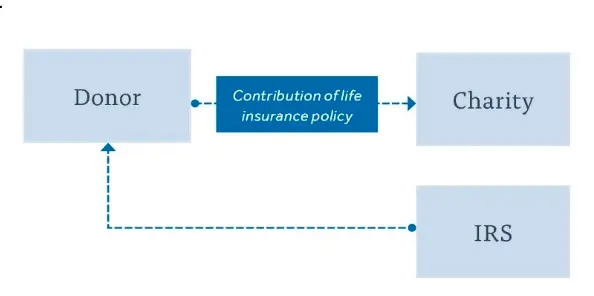
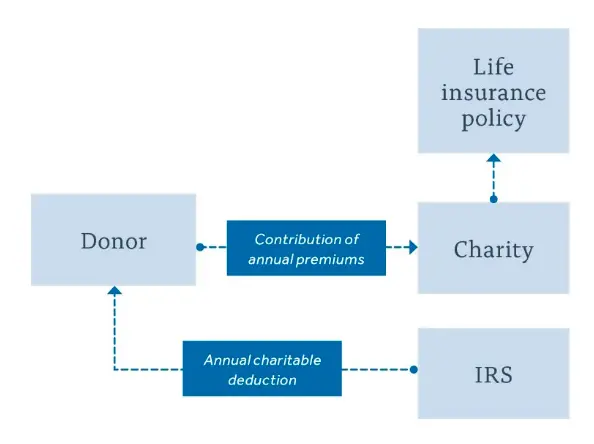
The contribution of a premium-paying policy is trickier than that of a single pay policy. The effectiveness of this technique depends on each state’s determination as to whether the charity has an insurable interest in the donor. If the donor contributed additional amounts to the charity to fund ongoing premium payments, the deduction will be limited to 60% of adjusted gross income (AGI). If the donor pays ongoing premiums directly to the insurance company the deduction is limited to 30% of AGL Any amount in excess of the deduction limits in a single year can be carried forward to offset income tax for five years.
Another gifting method involves creating a new policy for the charity. Under this method, the donor would either donate a new policy to the charity or the charity would obtain an insurance policy on the donor. The donor would fund the premium payments by making continuing cash contributions to the charity. This option may be more suitable for a younger donor since the premium cost generally would be low compared to the ultimate death benefit, and the donor retains the option to discontinue the payment of premiums, whereby the charity as owner of the policy would have the right to: (1) continue paying those premiums themselves or (2) surrender the policy for its cash value.
If the donor contributes the premium payments directly to the charity, then the charitable deduction representing those premiums is limited to 60% of the donor’s AGI for the year of the donation. If the donor pays the premiums to the insurance company, the deduction is limited to 30% of AGI for the year of the donation. Any amount in excess of the charitable deduction limits for a single year can be carried forward an additional five years to offset income in those years.
Life Insurance Policy Valuation
To determine the appropriate deduction upon a transfer of a life insurance policy to charity, it will be necessary to determine the policy’s value. The U.S. Treasury Department has issued final regulations regarding the valuation of a life insurance policy in certain circumstances, including when it is transferred from a qualified plan to a participant, from an employer to an employee, or for taxation of permanent benefits under a group term life insurance plan. 1 The final regulations state that the value of the policy in such situations is its fair market value.
Also, the Internal Revenue Service (part of the Treasury Department) has issued Revenue Procedure 2005-25, providing two safe-harbor formulas for determining the fair market value of a life insurance policy, retirement-income contract, endowment contract, or other contract providing life insurance protection for purposes of applying the rules of Internal Revenue Code (IRC) §§402, 79, and 83(a). Under Rev. Proc. 2005-25, the fair market value safe harbor for a non-variable life insurance contract is the greater of ITR (interpolated terminal reserve), or PERC (premiums plus earnings minus reasonable charges) multiplied by the average surrender factor.


400 Pinner Weald Way, Suite 102
Cary, NC 27513


